by Andy Coghlan on 12 June 2014, from NewScientist Website
A reservoir of water three times the volume of all the oceans has been discovered deep beneath the Earth's surface.
The finding could help explain where Earth's seas came from.
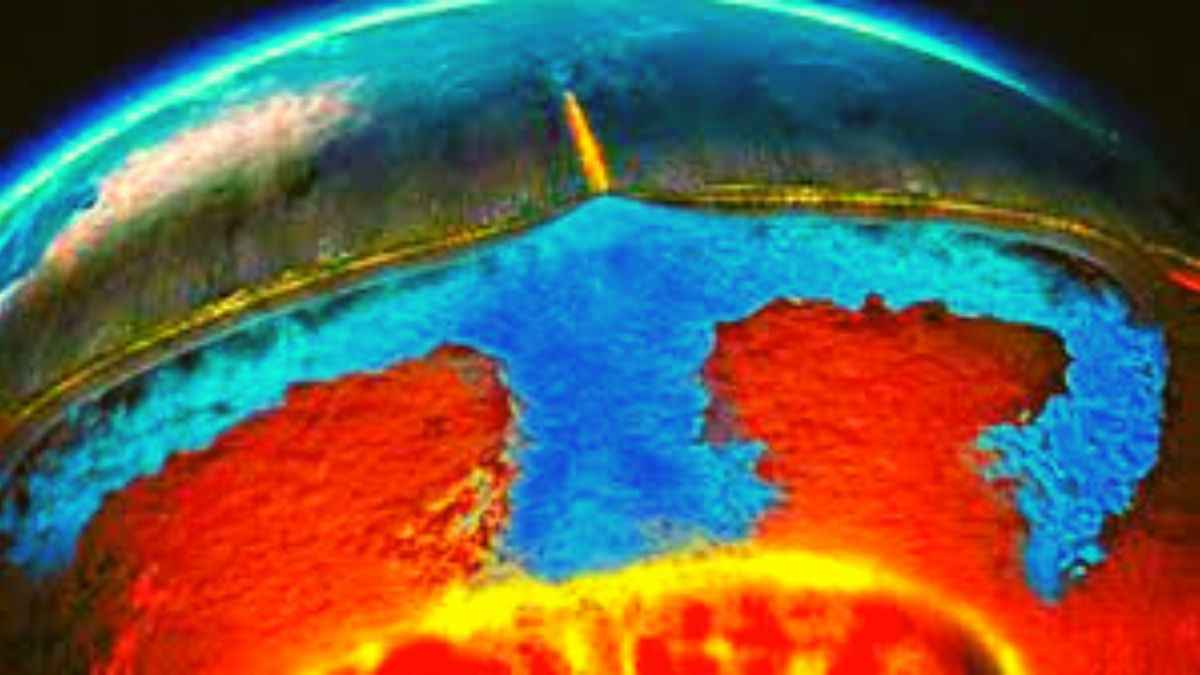
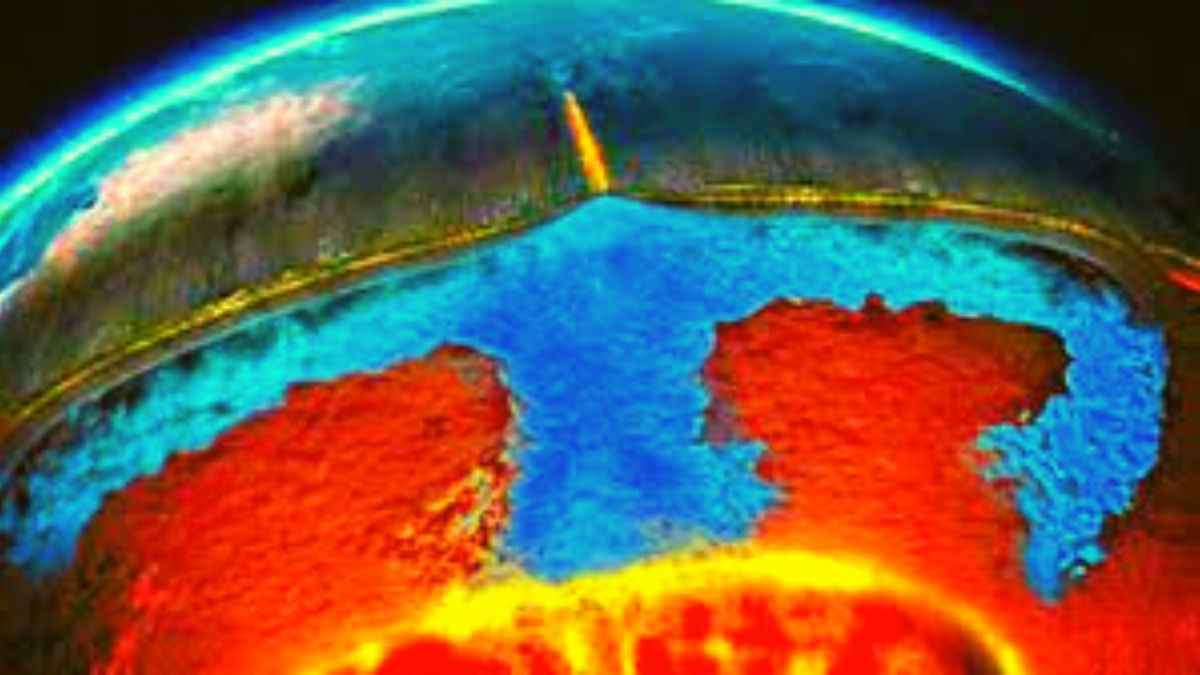
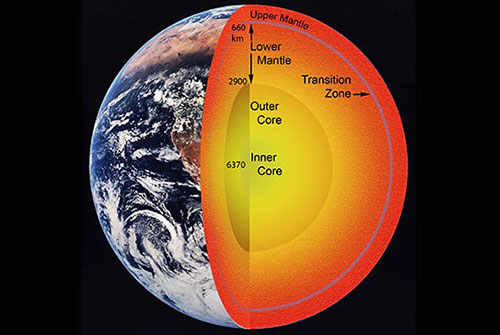
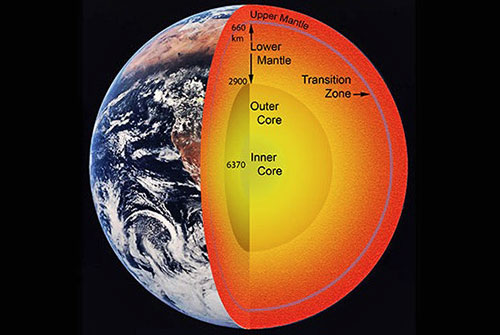
The water is hidden inside a blue rock called ringwoodite that lies 700 kilometers underground in the mantle, the layer of hot rock between Earth's surface and its core.
The huge size of the reservoir throws new light on the origin of Earth's water.
"It's good evidence the Earth's water came from within," says Steven Jacobsen of Northwestern University in Evanston, Illinois.
The hidden water could also act as a buffer for the oceans on the surface, explaining why they have stayed the same size for millions of years.
Pinging the planet
Steven Jacobsen'steam used 2000 seismometers to study the seismic waves generated by more than 500 earthquakes.
These waves move throughout Earth's interior, including the core, and can be detected at the surface.
"They make the Earth ring like a bell for days afterwards," says Jacobsen.
By measuring the speed of the waves at different depths, the team could figure out which types of rocks the waves were passing through.
The water layer revealed itself because the waves slowed down, as it takes them longer to get through soggy rock than dry rock.
Jacobsen worked out in advance what would happen to the waves if water-containing ringwoodite was present.
He grew ringwoodite in his lab, and exposed samples of it to massive pressures and temperatures matching those at 700 kilometers down.
Sure enough, they found signs of wet ringwoodite in the transition zone 700 kilometers down, which divides the upper and lower regions of the mantle.
At that depth, the pressures and temperatures are just right to squeeze the water out of the ringwoodite.
"It's rock with water along the boundaries between the grains, almost as if they're sweating," says Jacobsen.
Damp down there
Jacobsen's finding supports a recent study by Graham Pearson of the University of Alberta in Edmonton, Canada.
Pearson studied a diamond from the transition zone that had been carried to the surface in a volcano, and found that it contained water-bearing ringwoodite, the first strong evidence that there was lots of water in the transition zone.
"Since our initial report of hydrous ringwoodite, we've found another ringwoodite crystal, also containing water, so the evidence is now very strong," says Pearson.
So far, Jacobsen only has evidence that the watery rock sits beneath the US.
He now wants to find out if it wraps around the entire planet.
"We should be grateful for this deep reservoir," says Jacobsen.
"If it wasn't there, it would be on the surface of the Earth, and mountain tops would be the only land poking out."
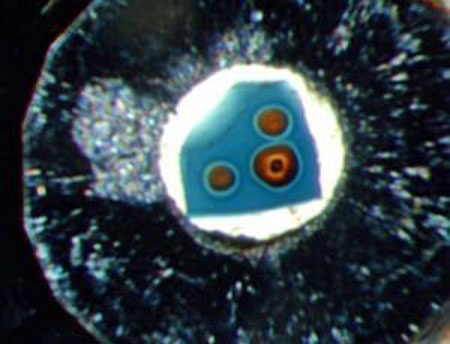
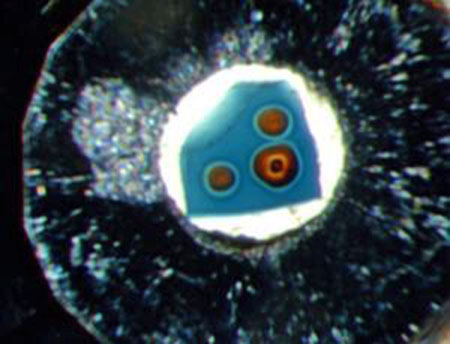
Blue lagoon: this crystal of blue ringwoodite is being crushed in a lab experiment. The orange circles are regions that have had their water squeezed out of them (Image: Steve Jacobsen/Northwestern University)
351 KB
View full-sizeDownload
by Rik Myslewski on 13 June 2014, from TheRegister Website
Can it help relieve a drought-plagued world?
Well, don't water that brown lawn just yet.
A group of US researchers has discovered evidence that deep below the Earth's surface there may be as much as three times as much water as in all of our oceans combined.
Unfortunately, at such extreme depths, the new-found treasure trove of H2O won't be slaking anyone's thirst
253 KB
View full-sizeDownload
"The high water storage capacity of minerals in Earth's mantle transition zone (410 to 660 kilometer depth) implies the possibility of a deep H2O reservoir," reports the abstract of a paper published in Science on Friday entitled "Dehydration Melting at the Top of the Lower Mantle".
"I think we are finally seeing evidence for a whole-Earth water cycle, which may help explain the vast amount of liquid water on the surface of our habitable planet," said one of the paper's coauthors, geophysicist Steve Jacobsen of Northwestern University when announcing his team's research.
"Scientists have been looking for this missing deep water for decades."
This is not, we hasten to say, the same form of water as fish swim in, clouds are formed by, from which icebergs calves from glaciers are composed, or which we silly humans pay exorbitant amounts of money to sip from plastic Dasani bottles.
Rather, it is bound up in a mineral called ringwoodite.
"The weight of 250 miles of solid rock creates such high pressure, along with temperatures above 2,000 degrees Fahrenheit, that a water molecule splits to form a hydroxyl radical (OH), which can be bound into a mineral's crystal structure," Northwestern's announcement explains.
"The ringwoodite is like a sponge, soaking up water," Jacobsen says.
"There is something very special about the crystal structure of ringwoodite that allows it to attract hydrogen and trap water."
But,
How did the water get down there in the first place?
And why is it pooling - well, not exactly "pooling," but you get our drift - at a specific transition zone between the Earth's upper and lower mantle?
The answer to that first question is that the Earth is not a static system.
Rather, its constituent parts are constantly roiling, upwelling and downwelling, with water being drawn down to great depths, the research explains, through the subductive forces that animate plate tectonics.
That's what is drawing the water downward into the melted rock under the Earth's crust - a reasonable explanation unless you, like US congressman Joe Barton (R-TX), don't believe in plate tectonics.
But we digress - let's move on to the second question.
As the water-bearing ringwoodite continues its downward movement from the upper mantle and through the transition zone, it contains a significant amount of water: up to one per cent of its weight.
However, as it sinks into the lower mantle, it forms into a high-pressure mineral called silicate perovskite, which can hold almost none.
"When a rock with a lot of H2O moves from the transition zone to the lower mantle it needs to get rid of the H2O somehow, so it melts a little bit," coauthor Brandon Schmandt of the University of New Mexico says.
"This is called dehydration melting."
Steve Jacobsen concurred.
"Once the water is released, much of it may become trapped there in the transition zone."
So there it sits - in enormous volumes, it appears.
Jacobsen, Brandon Schmandt, and the rest of their team base their hypothesis on work done using the USArray, a continental-scale network of over 2,000 seismometers spread across the United States, and so their findings can only specifically be applied to the water-soaked transition zone they discovered beneath the area they studied.
But there's little reason to believe that the same results wouldn't apply globally.
If so, the implications of this discovery are well summarized by the subtitle of the Northwestern University announcement:
"Water bound in mantle rock alters our view of the Earth's composition."